

A business owner called us last year in a state of near panic. One of his employees had received a voice note that sounded exactly like him, asking for an urgent transfer to a “new supplier” account. The tone, the pauses, even the way he said the employee’s name were right. The money left the account within the hour, and he only found out when he asked about the payment the next morning. He had never recorded that message. Someone had copied his voice from a few video clips posted online and fed them into a cheap AI tool.
Stories like this are no longer rare. Faces, voices, and videos can now be faked well enough to fool people who know you personally. The question we hear most often is simple: does Pakistani law actually protect us, and can we take legal action? The honest answer is yes, in most cases, but not through a law that says the word “deepfake”.
Is There a Deepfake Law in Pakistan?
As far as we are aware, Pakistan does not yet have a statute written specifically for AI-generated deepfakes. The Prevention of Electronic Crimes Act 2016, known as PECA, was drafted long before synthetic media became common, and it does not define a deepfake as a separate offence. Academic commentary and news reports have pointed to this gap for some time, and a draft Punjab Performers’ Digital Identity and Artificial Intelligence Protection Act 2026 has been discussed as one attempt to treat a person’s face, voice, and digital identity as protected property.
That does not mean you are left without remedies. Pakistani police and courts have been applying the existing sections of PECA to deepfake cases, and the 2025 amendments added further tools. When Punjab Police registered several FIRs in early 2025 over AI-generated videos of a senior public figure, they relied on PECA and on the defamation provisions of the Pakistan Penal Code, which shows that the law can be stretched to cover this kind of harm. The real question in any case is which section fits your facts.
Which Laws Can Be Used Against Deepfakes?
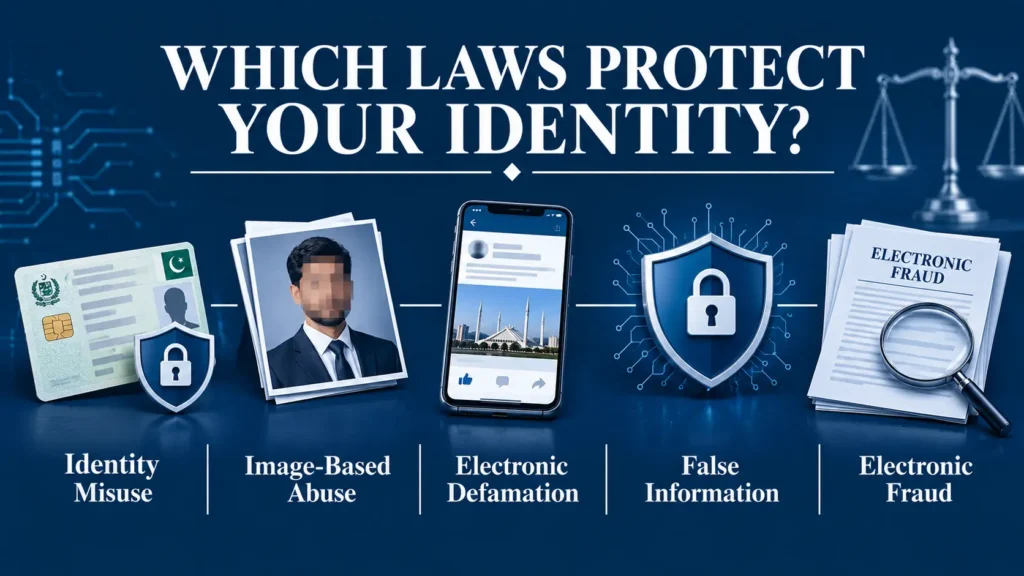
If someone has used your name, photograph, voice, or other identifying details without permission, the most direct provision is Section 16 of PECA, which deals with the unauthorised use of identity information. It carries a punishment of up to three years in prison, a fine of up to five million rupees, or both. This is the section most often relevant to fake profiles, cloned voices used to cheat people, and fabricated videos that present someone as saying or doing something they never did.
Where the deepfake is sexual or intimate in nature, Section 21 becomes the key provision. It deals with offences against the dignity and modesty of a person and covers morphed or manipulated images and videos used to harass, shame, or blackmail. It is treated seriously, with imprisonment of up to five years and a fine of up to five million rupees, and the punishment is heavier where the victim is a minor. It applies whether the material is real or fabricated, which matters because the person who made it cannot defend himself by saying the video is not genuine. Where the person making threats keeps contacting or monitoring the victim, the cyber stalking provision in Section 24 may also apply.
Section 20 deals with electronic defamation and can be used where a deepfake is designed to damage your reputation, for example a fake video that shows a doctor, teacher, or businessman doing something shameful. The 2025 amendments also introduced Section 26-A on false or fake information, which has been discussed in connection with AI-generated content, although it has also been controversial because critics worry about its effect on free speech. Where money has been taken by a cloned voice or a fake video, the offences of electronic fraud and forgery under Sections 13 and 14 may also be relevant.
How to Take Action Step by Step
The first thing to do is not to delete anything. Save the video, image, or voice note in its original form, copy the direct link of the post, and record the account name, the date, and the time. Take screen recordings as well as screenshots, because a recording shows the context. Under Article 164 of the Qanun-e-Shahadat Order 1984, electronic evidence can be presented in court, but the other side will usually challenge it, so the cleaner and more complete your records are, the better. If the deepfake was sent to you privately, keep the original device and the original chat.
The next step is to report the content to the platform and ask for removal. Most major platforms have a route for impersonation, non-consensual intimate content, and manipulated media. Do this at the same time as you prepare your formal complaint, not instead of it, because a platform’s takedown does not punish the offender and the platform’s data may disappear after some time.
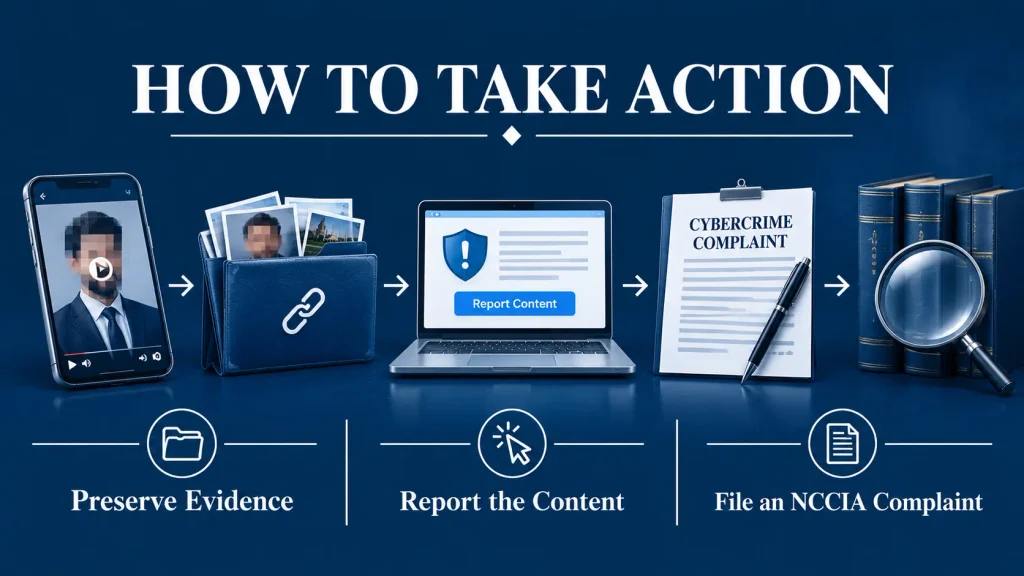
Then file a complaint with the National Cyber Crime Investigation Agency, which became the statutory investigating agency for PECA offences after the 2025 amendment. Complaints can be made through its online portal at complaint.nccia.gov.pk or through the helpline at 1799, and you will need your full name and CNIC because anonymous complaints are not accepted. When you describe the problem, say clearly that the content is AI-generated and explain which parts are fake, because that helps the agency decide whether forensic analysis is needed. We explain the filing process in more detail in our guide on how to file a cyber crime complaint in Pakistan.
PECA also allows a victim to ask the Pakistan Telecommunication Authority to have unlawful content blocked or removed, and this can run alongside the criminal complaint. Where the deepfake is intimate, the rules governing PECA investigations also restrict officers from disclosing the victim’s identity, which many people find reassuring when they are deciding whether to come forward.
Civil Remedies and Compensation
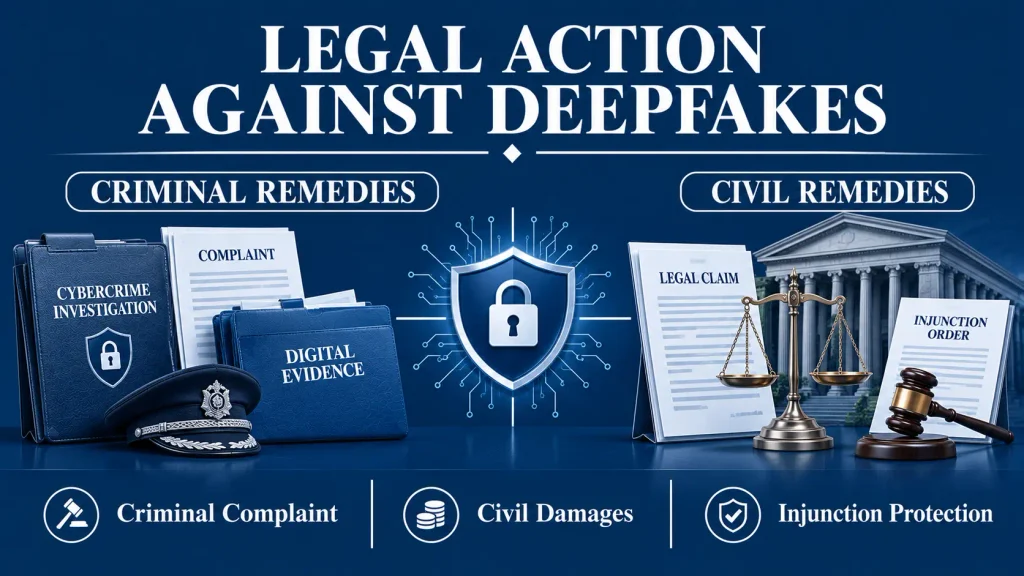
A criminal complaint punishes the offender but does not automatically compensate you. If the deepfake has damaged your reputation, cost you a contract, or caused you to lose your job, you may also bring a civil claim for damages under the Defamation Ordinance 2002 and ask the court for an injunction to stop further publication. These cases have strict time limits, which we explain in our guide on how to sue for defamation in Pakistan. It is worth speaking to a lawyer early, because waiting to see whether the problem disappears is the most common way people lose their options.
Deepfake Scams Are Growing
The Securities and Exchange Commission of Pakistan warned the public on 21 November 2025 about AI-generated advertisements on social media that used the faces of celebrities, finance influencers, and brokerage executives to draw people into fake share trading groups on WhatsApp. This is a useful reminder that deepfakes are not only used for harassment. They are also used for fraud, and the victims are often ordinary investors who trusted a familiar face. If you have lost money, tell your bank immediately, preserve the transaction details, and include them in your complaint, since the bank may be able to freeze or trace the funds if it acts quickly.
What the Law Cannot Do Yet
It is important to be realistic. Because PECA does not use the word deepfake, the way a section is applied can differ from case to case, and offenders who use foreign platforms, VPNs, or fake accounts can be difficult to identify. Investigations also depend on cooperation from platforms that are based outside Pakistan. None of this means a complaint is pointless. It means the strength of your case often depends on how early you act, how well you preserve evidence, and whether the facts are matched to the right sections from the start.
Frequently Asked Questions
Is making a deepfake of someone illegal in Pakistan? There is no separate deepfake offence, but creating or sharing one can fall under PECA, for example Section 16 for misusing identity information, Section 21 for intimate or manipulated images, and Section 20 for defamation, depending on the facts.
Can I take legal action if someone cloned my voice? Yes, particularly where the cloned voice was used to cheat people or to represent you falsely. Section 16 and the fraud provisions of PECA may apply, and a civil claim for damages may also be possible.
Where do I report a deepfake in Pakistan? You can file a complaint with the NCCIA through its online portal or helpline, and also report the content to the platform where it was posted.
Do I have to reveal my identity when I complain? The NCCIA requires your name and CNIC for a complaint, although investigators handling offences against modesty are restricted from disclosing a victim’s identity.
Final Thoughts
Deepfakes feel overwhelming because they attack something personal: your face, your voice, your word. The law is not perfect, but it is not empty either, and people who act quickly, keep clean evidence, and choose the right provisions often get real results. Our team handles online harassment, identity misuse, and related claims under our cyber law practice. If someone is using your identity right now, contact us and we will help you decide what to do first.