
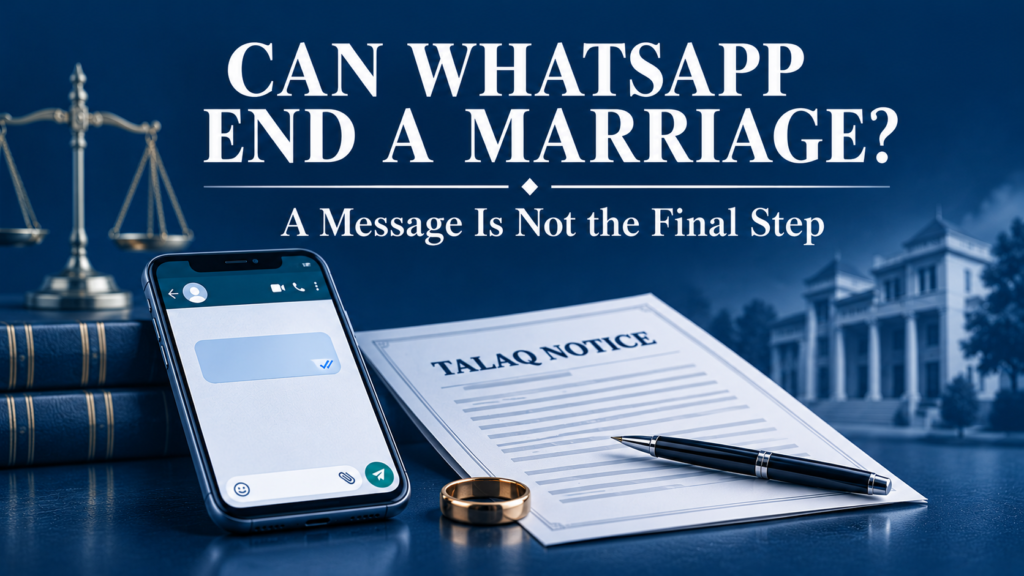
A woman once showed us her phone at the first meeting. At 2 a.m. her husband had sent a single message that ended with the word talaq, and then he stopped answering. She did not know whether she was still married, whether she could stay in the house, or whether the message even counted. Her family was split between those who said “it is over” and those who said “a message means nothing.”
Both sides were partly right, which is exactly why this question causes so much damage. Here is what Pakistani law actually says.
The Short Answer
A husband can pronounce talaq in writing, and a text message can be the form in which he does it. But a pronouncement on SMS or WhatsApp does not, by itself, end a marriage in Pakistan. The law requires a written notice to the Union Council and a 90-day waiting period before talaq takes effect.
1. The message can count as a pronouncement of talaq, or as proof that one was made
2. It does not finish the divorce on its own
3. The marriage continues legally until the statutory process is complete
4. Anything done as if the marriage had already ended can create serious problems
Why the Words “In Any Form Whatsoever” Matter
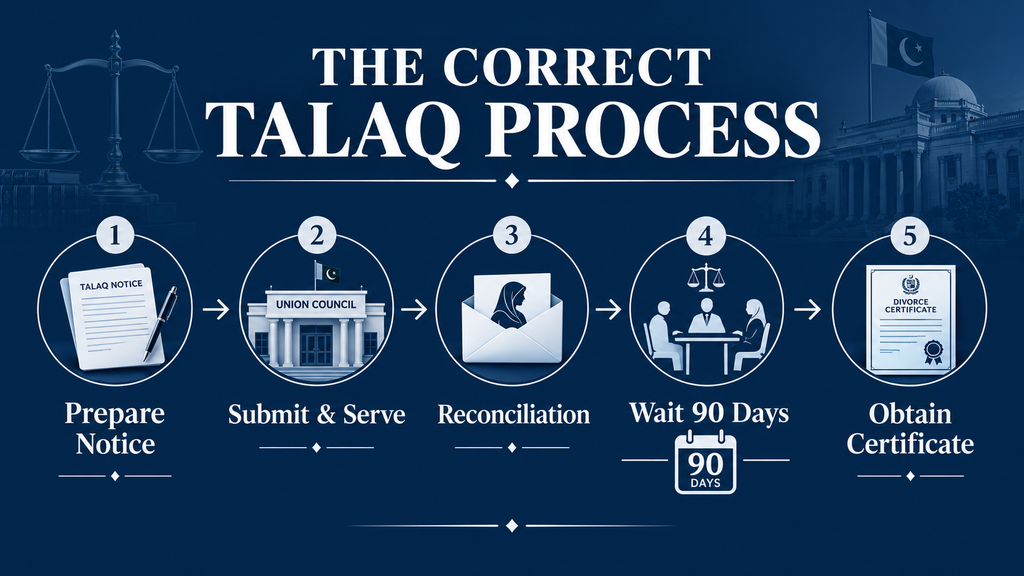
Section 7 of the Muslim Family Laws Ordinance 1961 applies when a man pronounces talaq “in any form whatsoever”. That wording is important because it means the law does not ask whether the talaq was spoken, written, or sent electronically. It asks what the husband must do next.
1. He must give written notice to the Chairman of the Union Council as soon as possible
2. He must give a copy of the notice to his wife
3. The Union Council relevant to the wife’s residence at the time of pronouncement is generally the right office
4. The talaq takes effect after 90 days from the notice, unless it is revoked earlier, and after the end of the pregnancy if the wife is pregnant
The Supreme Court has been reported as repeating that all forms of talaq remain ineffective for 90 days and that a revocation within that period is valid. Whether the form was spoken, written, or sent on a phone, the same clock applies.
On the religious side, many scholars accept a written talaq when the intention is clear, which is why a text can matter as a pronouncement. The statutory procedure is what then decides when the divorce becomes legally effective in Pakistan.
What Has to Happen After the Message
1. The husband prepares a written talaq notice with both spouses’ details and the date of pronouncement
2. The notice is submitted to the correct Union Council, and a receiving copy is kept
3. A copy is sent to the wife by a trackable method
4. The Arbitration Council is formed to attempt reconciliation
5. If reconciliation fails, talaq takes effect after the 90 days
6. The Union Council certificate is collected and records are updated
We cover the mistakes people make at each stage in our guide to talaq notice mistakes in Pakistan.

Is a WhatsApp or SMS Message Valid Evidence?
Yes, in many cases. Pakistani courts can admit electronic messages as evidence, and that works in both directions.
1. Article 164 of the Qanun-e-Shahadat Order 1984 allows courts to admit evidence made available by modern devices, which covers SMS and WhatsApp
2. The Electronic Transactions Ordinance 2002 recognises electronic documents and records
3. In Mian Khalid Perviz v The State (2021 SCMR 522), the Supreme Court accepted digital documentary evidence as admissible under these provisions
4. Admissible does not mean automatically proven. If the other side denies the message, you must still prove who sent it, when, and that it is genuine
A plain screenshot is the weakest form of proof, because it can be challenged as edited or taken out of context. Keep the original chat on the original device, and note the sender’s number and the date and time.
If You Are the Husband
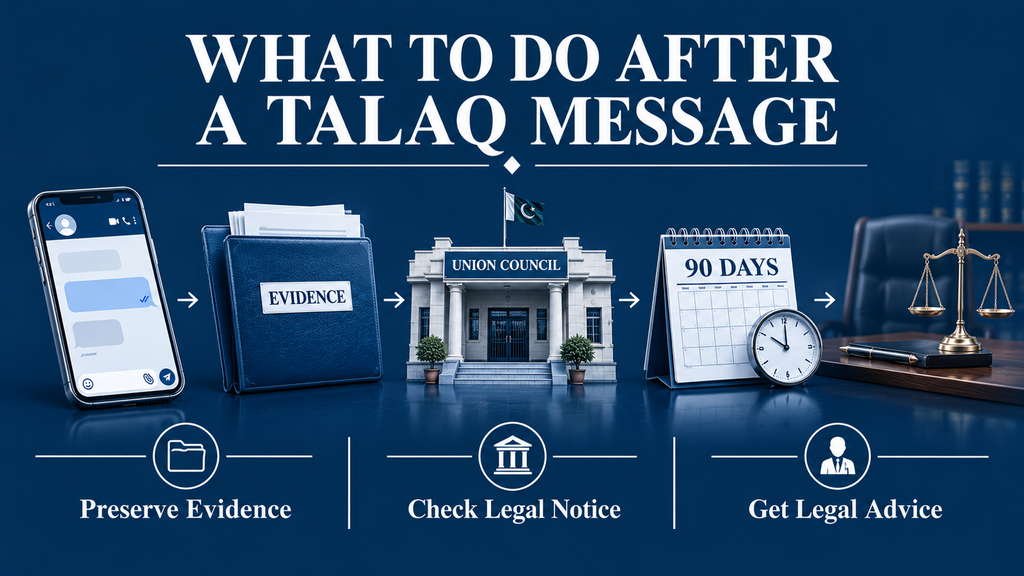
1. Do not treat a message as the end of the process. Complete the Union Council notice
2. Do not delete the chat. It may be used as evidence of exactly what you said
3. If the message was sent in anger and you did not mean it, revocation within the 90-day period is possible, and it should be done clearly and in writing
4. Do not remarry or act as if you are divorced before the process is complete
If You Are the Wife
1. Preserve the message, the sender’s number, and the time it was sent. Do not delete anything
2. Check with the Union Council whether a notice has actually been filed and note the date
3. Attend the Arbitration Council proceedings and put your financial and custody claims on record
4. Dower, maintenance during the waiting period, and child maintenance are not cancelled by a message
5. If you want to end the marriage yourself, a khula suit is a separate route that does not depend on the husband’s notice
When One Spouse Is Abroad
Overseas Pakistanis often receive or send talaq on WhatsApp, and that is where confusion is greatest. The notice must still reach the correct Union Council in Pakistan, and proof of delivery to the wife becomes harder across borders. A lawyer acting under a properly attested Power of Attorney can file the notice and follow the process. See our overseas legal services for how this works.
Common Myths
1. “One WhatsApp message and we are divorced.” The statutory notice and 90 days are still required
2. “A message has no value.” It can be pronouncement or evidence, and courts can admit it
3. “The wife must agree to talaq.” She does not have to agree, but she has rights during and after the process
4. “If I deleted the message, it never happened.” Phone records, backups, and the other person’s phone may still prove it
Final Thoughts
A text can start a divorce, but it cannot finish one. The law cares less about the form of the words than about what happens afterwards: notice, waiting period, reconciliation, and records. If you have sent or received a talaq message and do not know where you stand, get advice before you act. Contact us and our team will explain your position and the next steps.