
A man called our office at 11 at night because two policemen had just left a notice at his door. He had been named in an FIR filed by a business partner after a payment dispute, and he had no idea what the notice meant. His first instinct was to wait a few days and see if it “settled down”. It did not. By the time he came to see us, the police had already visited his workplace twice, and the window to apply for protection from arrest was getting narrower.
If you are in that position now, take a breath. A false FIR is stressful, but the law gives you real remedies, and the order in which you use them matters.
Why False FIRs Happen
Police are legally required to register an FIR when information discloses a cognizable offence, and they do not decide at that stage whether the story is true. That is why FIRs can be registered on false or exaggerated allegations.
1. Property and possession disputes are a common trigger
Family and matrimonial conflicts often produce criminal complaints as pressure
Business and payment disputes sometimes get turned into criminal cases
Personal rivalries and political motives play a role in some cases
Pakistani law does not define a “false FIR” as a separate category. Falsity is judged through malice, knowledge of the falsehood, and the evidence, which is why your response needs to be organized, not emotional.
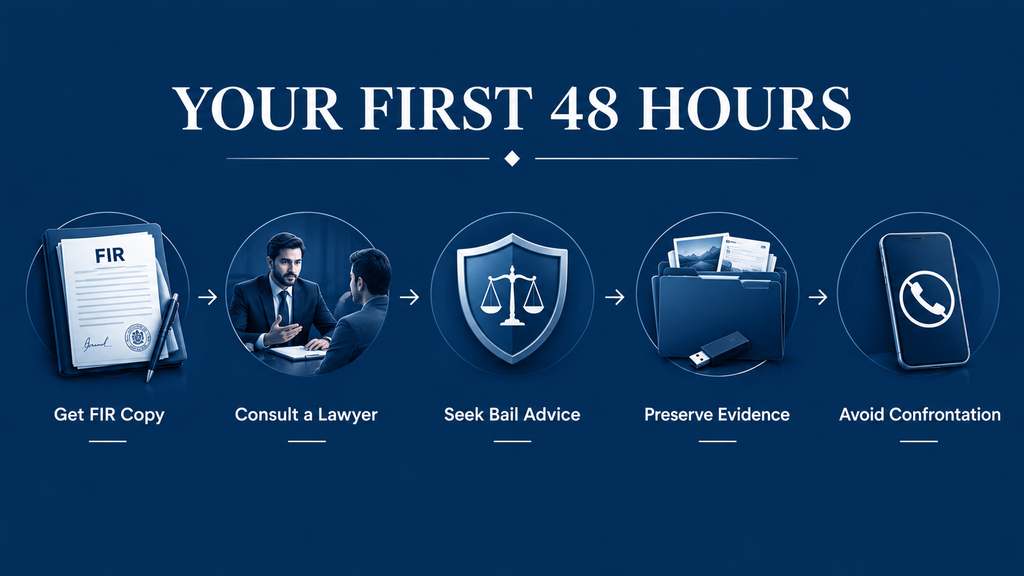
The First 48 Hours: What to Do Right Away
1. Get a copy of the FIR. You are entitled to know exactly what you are accused of, under which sections, and by whom.
2. Do not ignore police notices. A missed notice can be used against you later and can lead to a worse situation than the FIR itself.
3. Speak to a criminal lawyer immediately, before you speak to the investigating officer.
4. Apply for pre-arrest bail. Under Section 498 of the CrPC, the High Court or Sessions Court can order that you not be arrested for a period or until the application is decided. The court usually looks for signs of mala fide intent, false implication, or harassment.
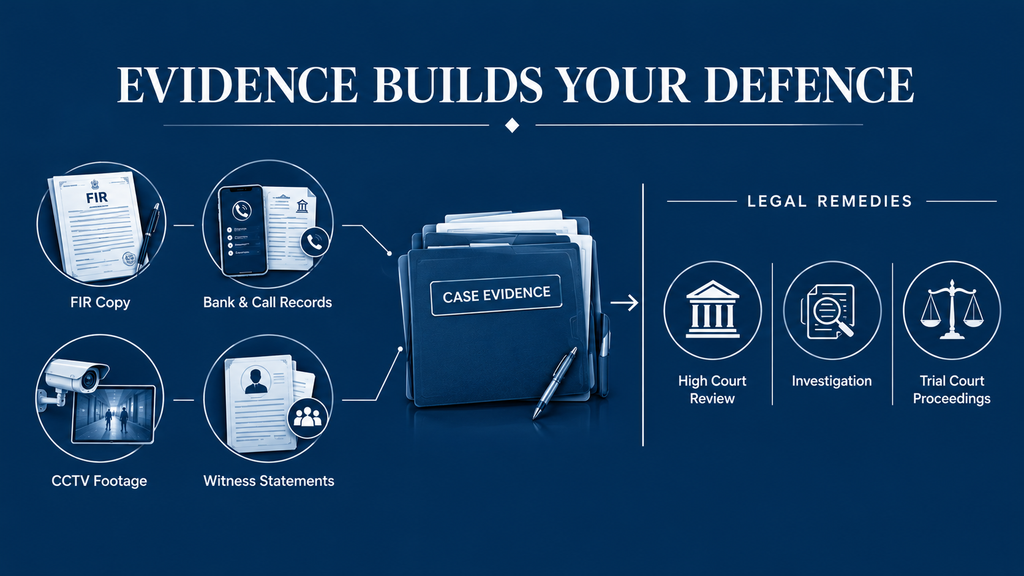
5. Preserve your evidence now. Collect call records, messages, bank transfers, location data, CCTV, receipts, and witness names that show where you were or what really happened.
6. Avoid contacting the complainant in a way that could be described as pressure or threats.
If the offence is bailable, bail is a right. For non-bailable offences it is at the court’s discretion, and for offences punishable below ten years it is generally the rule rather than the exception.
Four Ways to Challenge a False FIR
Different remedies work at different stages, and a good lawyer will choose based on how far the case has progressed.
1. During investigation: present your documents and witnesses to the investigating officer. If the evidence does not support the allegation, the accused can be released under Section 169 CrPC, or the police can submit a cancellation report under Section 173, which the Magistrate then reviews. A cancellation report is one of the several types of police challan, and it is not always the end of the matter.
2. Quashing in the High Court: under Section 561-A CrPC, the High Court can quash an FIR in appropriate cases, for example where the facts alleged do not disclose any offence, or where the FIR is clearly malicious or an abuse of process.
3. Early acquittal during trial: if the case reaches court and the evidence is weak, an application under Section 265-K (Sessions Court) or Section 249-A (Magistrate) can seek acquittal without going through the full trial.
4. Full trial and acquittal: if none of the above ends the case, the prosecution must still prove its case beyond reasonable doubt.
Quashing is not automatic. Courts are cautious about stopping an investigation early, so a strong, document-backed petition matters more than a long one.
Can You Take Action Against the Person Who Filed It?
Yes, but set realistic expectations. These remedies are usually pursued after the false nature of the case has been established, often after an acquittal or cancellation.
1. Section 211 PPC (false charge made to injure): up to two years in prison, a fine, or both, and up to seven years where the false charge is of a very serious offence
2. Section 182 PPC (false information to a public servant): a shorter prison term, up to six months, and the procedure for such prosecution usually runs through the court or public servant concerned
3.Section 250 CrPC: a Magistrate can order compensation where the accusation is found false, frivolous, or vexatious, but the printed text caps it at Rs 25,000
4. Defamation: if the false accusation was also published or spread, you may have a separate civil or criminal claim, which we cover under defamation matters
Because the statutory compensation cap is low, many people find the real value is in clearing their name and discouraging repeat misuse, not in the amount awarded.
When the FIR Comes From a Family Dispute
A large share of false or exaggerated FIRs arise from divorce, custody, or maintenance conflicts. If your situation is part of a larger marital or family dispute, handling the criminal case and the family case together is important, since statements in one can affect the other. Our family law team deals with both sides of these cases.
What Not to Do
1. Do not hide, run, or switch off your phone. It makes you look guilty and can hurt your bail application
2. Do not pay a “settlement” or sign anything at the police station without a lawyer reading it first
3. Do not threaten the complainant or their family
4. Do not post accusations online, because that can expose you to a defamation claim of your own
5. Do not assume the case will fade away. Unattended FIRs tend to move forward
A Fair Word of Caution
Not every FIR that you disagree with is false. Courts look at evidence, and a complaint can be incomplete or poorly documented without being malicious. Your strongest position is always factual: documents, timelines, and witnesses, not just your version of events.
Final Thoughts
The first week after a false FIR usually decides how hard the rest of the case will be. Get the FIR copy, secure bail protection, preserve your evidence, and choose your remedy based on the stage of the case. For background on how FIRs are registered in the first place, see our guide to the FIR process in Pakistan. If you have been named in a false FIR, contact us today and we will assess your case and tell you what to do next.