

A client once walked into our office holding a handwritten application he’d submitted to a police station three separate times. Each time, the duty officer told him his case “wasn’t serious enough” for an FIR and suggested he “settle it privately” instead. What he didn’t know, and what nobody at that station bothered to tell him, is that the officer had no legal discretion to refuse in the first place. The offence he was describing was cognizable, which meant registration wasn’t optional.
That gap between what the law requires and what actually happens at the counter is where most FIR problems in Pakistan start.
What Is an FIR, and When Does the Law Actually Require One?
A First Information Report (FIR) is the written record a police officer is legally required to prepare under Section 154 of the Code of Criminal Procedure, 1898, the moment they receive information about a cognizable offence. It’s the document that formally sets a criminal investigation in motion.
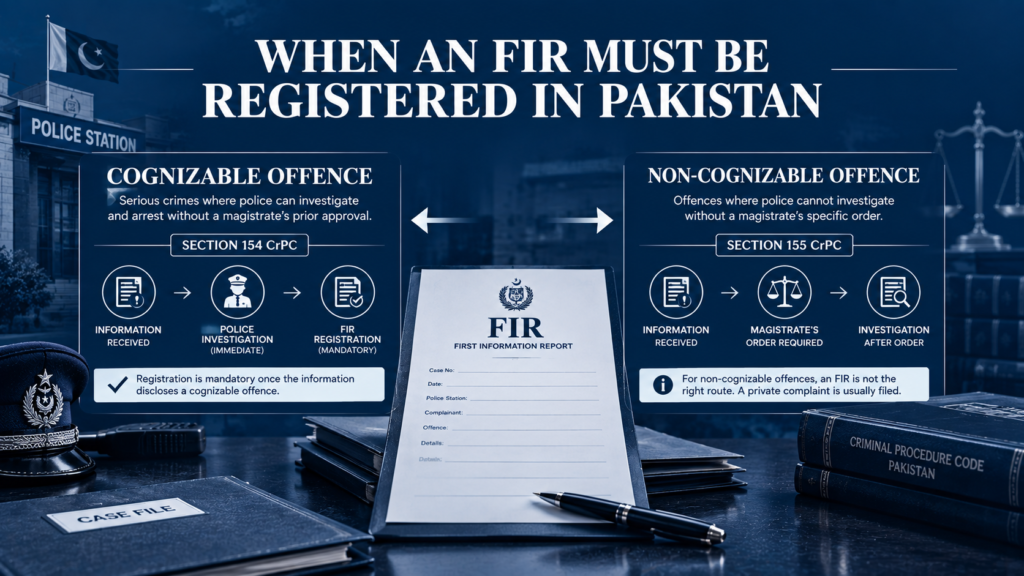
1. It applies specifically to cognizable offences, meaning serious crimes like murder, robbery, kidnapping, and grievous assault, where police can investigate and arrest without needing a magistrate’s prior approval
2. Registration is mandatory once the information discloses a cognizable offence. It is not left to the officer’s personal judgment
3. You’re legally entitled to a free copy of the FIR immediately after it’s registered
4. For non-cognizable offences, an FIR generally isn’t the right route at all
Cognizable vs Non-Cognizable: Why This Distinction Decides Everything
This single classification determines whether you even need an FIR in the first place.
1. Cognizable offences fall under Section 154 CrPC. Police can act immediately, investigate on their own authority, and arrest without a warrant
2. Non-cognizable offences fall under Section 155 CrPC. Police cannot investigate without a magistrate’s specific order, and the more common route is filing a private complaint directly with the magistrate under Section 200 CrPC
3. If it’s genuinely unclear which category an incident falls into, courts have held that police may conduct a brief preliminary inquiry first, but once a cognizable offence is disclosed, registration becomes mandatory without further delay
When You Should Actually Register One
There’s no fixed legal deadline for filing an FIR, but treating it as urgent matters more than most people realize.
1. File as soon as reasonably possible after the incident. A long, unexplained delay is one of the first things a defense lawyer will raise in court to question the complaint’s credibility
2. Register it for the actual offence involved, not a vaguer or lesser version of what happened. This affects everything from bail eligibility to which court eventually hears the case
3. If the matter involves an online element, such as fraud, harassment, or a fake account, it may also fall under cyber crime in Pakistan, which now runs through a separate reporting structure alongside the traditional FIR process
4. Keep any evidence, messages, receipts, or witness details ready before you go, since a well-documented complaint moves faster at every later stage
If the Police Refuse to Register Your FIR
This happens more often than it should, and the law gives you more than one way to push back.
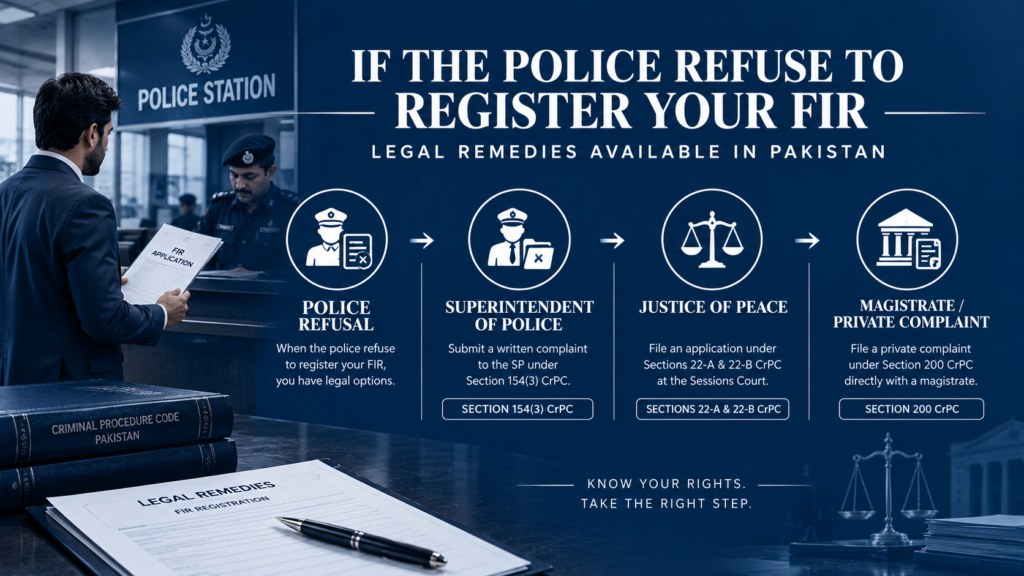
1. Submit a written complaint to the Superintendent of Police under Section 154(3) CrPC, explaining what happened and that registration was refused
2. File an application before the Justice of Peace under Sections 22-A and 22-B CrPC at the Sessions Court, which can directly order the police to register the case
3. File a private complaint under Section 200 CrPC directly with a magistrate, bypassing the police station entirely
4. In genuinely exceptional cases involving a fundamental rights violation, a constitutional petition under Article 199 remains available as a last resort
What Actually Happens After Registration
This is the part most people don’t get a clear explanation of, and it’s where a lot of anxiety about a pending case comes from.
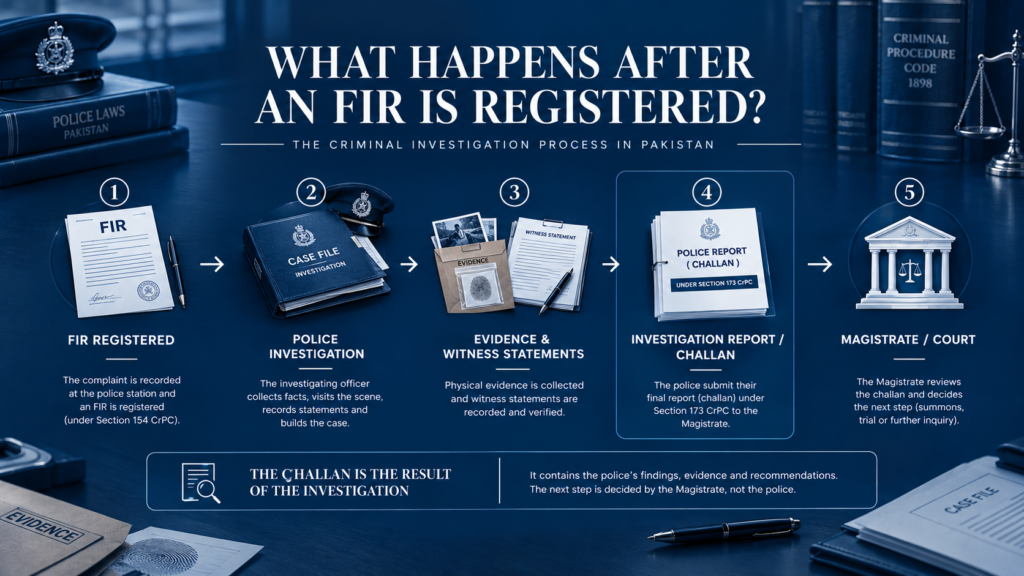
1. Investigation begins under Sections 156 to 173 CrPC, carried out by the assigned investigating officer
2. Evidence is gathered, statements are recorded, and depending on how the case develops, the police eventually submit a report to the magistrate
3. That report is what’s known as a challan, and there isn’t just one kind of it. We’ve covered the five different types of police challan and what each one means for your case in detail separately, which is worth reading once your FIR moves into this stage
4. If the complaint turns out to be false or filed with bad intent, the accused also has a remedy. The High Court can quash an FIR under Section 561-A CrPC where it doesn’t genuinely disclose a cognizable offence
FIR Registration Is Going Digital, Slowly
Punjab has been rolling out online FIR options through the Punjab Police app, also known as e-Police Post, though it’s currently limited to specific situations like mobile phone theft or loss rather than every type of case.
1. Citizens can also reach the IGP Complaint Center directly at 8787 for grievances about police conduct or delays
2. A recent app update added citizen FIR status tracking, so complainants no longer have to physically return to the station just to check progress
3. New registrations now require CNIC verification through the PakID and NADRA system, which is intended to reduce fake or duplicate complaints
When It’s Actually a Civil Matter, Not a Criminal One
Not every dispute belongs in an FIR to begin with. Plenty of disagreements over money, contracts, or property are genuinely civil law matters rather than criminal ones, and forcing a civil dispute into a criminal complaint usually backfires, wasting time on both sides before the case gets redirected anyway.
Final Thoughts
An FIR isn’t just paperwork. It’s the legal trigger that determines whether an investigation happens at all, and getting it registered correctly the first time saves months of avoidable back and forth later. If a police station has already turned you away, or you’re unsure whether your situation even qualifies, contact us and we’ll help you figure out the right next step before more time passes.