
A friend of mine got married last year without a single wedding hall, without a guest list, and without her family’s blessing at the time. What she did have was a lawyer, a stack of documents, and a lot of questions nobody in her family could answer honestly. Watching her go through the process taught me something most people don’t realize until they’re in the middle of it: a “court marriage” in Pakistan isn’t actually a wedding held inside a courtroom. It’s something far more practical, and far more misunderstood.
If you’re considering this route in 2026, here’s what actually happens, what’s changed recently, and what rights you’re really securing.
What Is Court Marriage in Pakistan, Really?
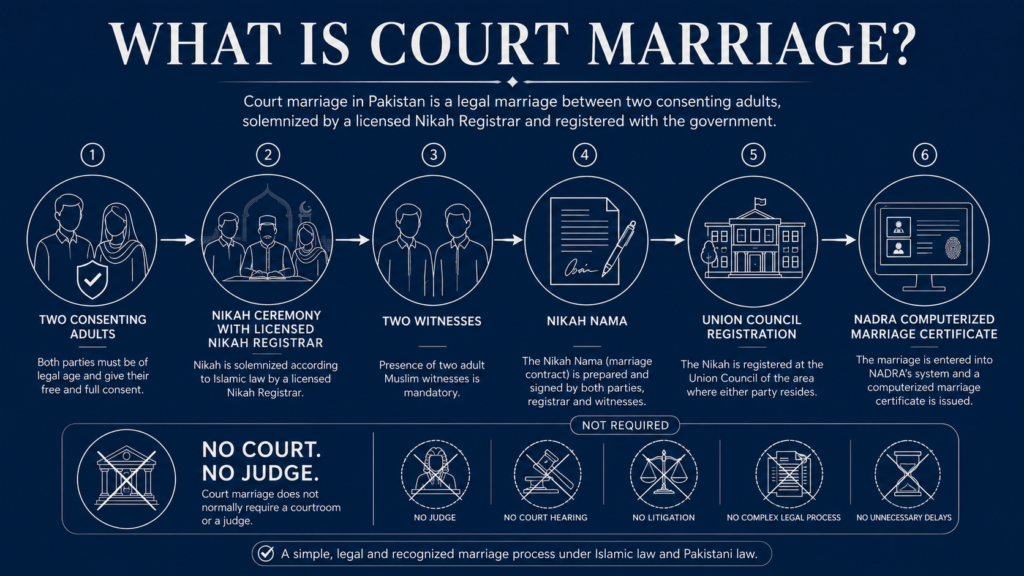
Court marriage in Pakistan is not a separate category of marriage. It’s a Nikah (the Islamic marriage contract) solemnized by a licensed Nikah Registrar, followed immediately by legal registration through the Union Council, so the marriage is documented by the state from day one instead of relying only on a private religious ceremony.
1. It requires no courtroom appearance or judge in most cases
2. It’s built around the free consent of two legally competent adults
3. It results in an official Nikah Nama and, later, a NADRA marriage certificate
4. Parental consent is not legally required once both parties are adults
The Legal Age Just Changed, and It Matters
If you searched this topic even a year ago, the answer to “what’s the legal marriage age in Pakistan” would have been messier than it should be. In 2026, that finally started to change.
Punjab, the country’s most populous province, spent decades under the Punjab Child Marriage Restraint Act of 1929, which set the marriage age at 18 for men but only 16 for women. In February 2026, the Punjab Governor signed an ordinance closing that gap, and on April 27, 2026, the Punjab Assembly formally passed the Child Marriage Restraint Bill 2026, setting the minimum marriage age at 18 for both men and women and making underage marriage a non-bailable offence.
Here’s where things currently stand across the country:
1. Punjab: 18 for both men and women (as of the 2026 reform)
2. Sindh: 18 for both, under the Sindh Child Marriage Restraint Act 2013
3. Balochistan and Islamabad Capital Territory: 18 for girls
4. Khyber Pakhtunkhwa: still 16 for girls, with reform efforts ongoing
Anyone contracting, facilitating, or promoting a child marriage in Punjab now faces up to seven years in prison and fines of up to Rs. 1 million. This matters well beyond the legal text. A UNICEF report found that roughly 18% of Pakistani women aged 20 to 24, close to 20.5 million people, were married before turning 18, which is exactly the pattern these 2026 reforms are trying to close.
The Step-by-Step Procedure
Once both parties meet the age and consent requirements, the actual process moves faster than most people expect.
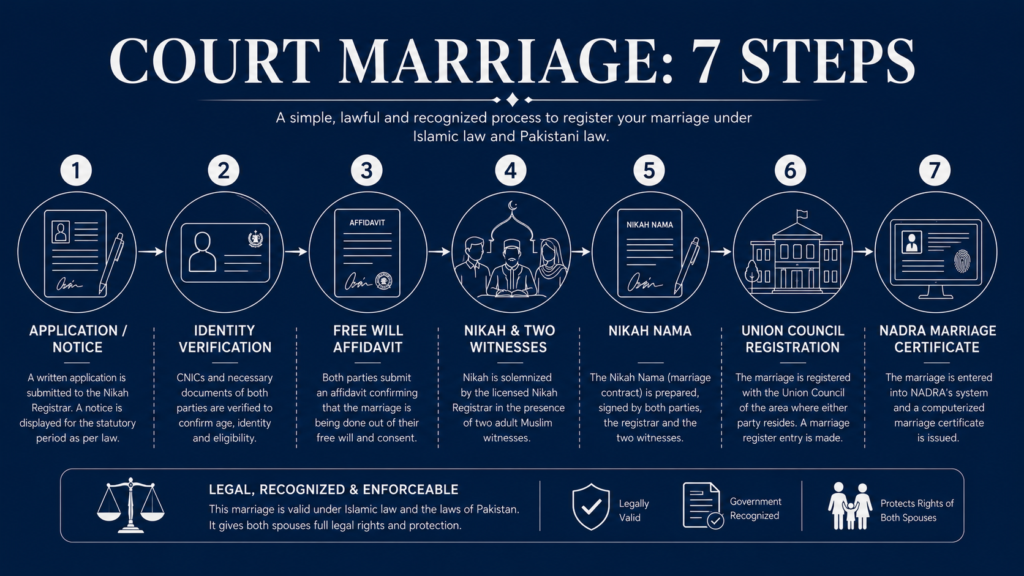
1. A written application or notice is submitted, usually through a family lawyer, confirming both parties’ intent to marry.
2. Identity documents are verified to confirm neither party is a minor and that consent is genuine.
3. Both individuals sign a Free Will Affidavit, stating they are marrying voluntarily and are legally eligible to do so.
4. The Nikah is solemnized by a licensed Nikah Registrar, with two witnesses present.
5. The Nikah Nama is completed, recording both parties’ details, the agreed Mahr (dower), and any special conditions.
6. The marriage is registered with the relevant Union Council.
7. Once registered, the couple can apply to NADRA for a computerized marriage certificate.
For interfaith marriages conducted under the Special Marriage Act, there’s an additional 30-day notice period during which objections can be filed before the marriage is solemnized.
Documents You’ll Actually Need
The exact list can shift slightly depending on your city and circumstances, but the core requirements are fairly consistent nationwide.
– Original CNICs of both parties
– CNICs of two witnesses
– Passport-sized photographs, usually four of each party
– A notarized Free Will Affidavit
– Divorce, Khula, or death certificate documents if either party was previously married
– For overseas Pakistanis: NICOP or POC, a valid passport, and an affidavit of free consent notarized at a Pakistani embassy
Missing even one document is the single most common reason a court marriage gets delayed by weeks instead of finished in a single day.
What Does It Actually Cost?
Fees vary by city, by how much legal assistance you use, and by whether you need same-day processing.
1. Islamabad: generally starts around Rs. 20,000 for standard processing
2. Rawalpindi: typically Rs. 15,000 to 25,000
3. Karachi and most other major cities: commonly Rs. 20,000 to 30,000
This usually covers the lawyer’s service fee, stamp paper, notarization, the Nikah Registrar’s fee, and Union Council registration charges. It’s a fraction of what a traditional wedding costs, but it’s not free, and “flat rate” quotes from unlicensed facilitators are one of the more common sources of fraud in this space.
The Legal Rights This Process Actually Protects
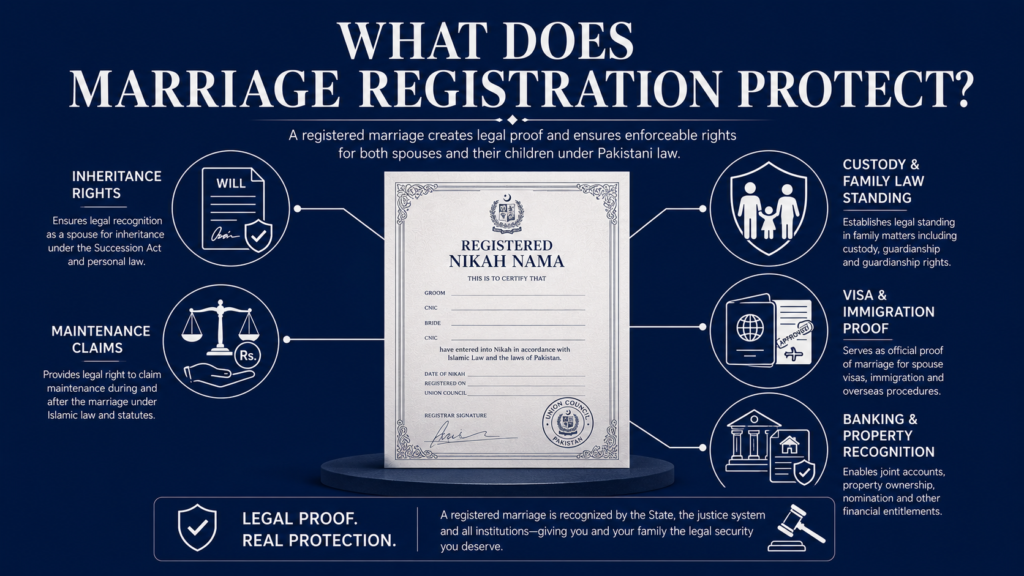
The paperwork isn’t just bureaucracy for its own sake. A properly registered marriage is what makes the following enforceable later, not just assumed:
1. Inheritance rights for both spouses under Pakistani succession law
2. The right to claim maintenance through the Family Courts Act, 1964
3. Legal standing in custody matters, should they ever arise
4. Recognized proof of marriage for visa, immigration, banking, and property purposes
5. Protection against a marriage later being disputed or denied by either family
An unregistered Nikah, even a religiously valid one, can leave a spouse with almost nothing to point to if a dispute comes up years later. Registration is what converts a private religious contract into something a court, a bank, or an embassy will actually recognize.
Final Thoughts
Court marriage exists precisely for situations like my friend’s: two adults who are legally entitled to marry but need a process that doesn’t depend on anyone else’s approval. The 2026 changes to the legal marriage age in Punjab are a genuine step toward closing a gap that’s existed for nearly a century, and they’re worth knowing whether you’re planning a marriage yourself or simply trying to understand where the law currently stands. If you’re going this route, treat the documentation stage as seriously as the ceremony itself. It’s what turns a Nikah into a marriage the law will actually stand behind.