
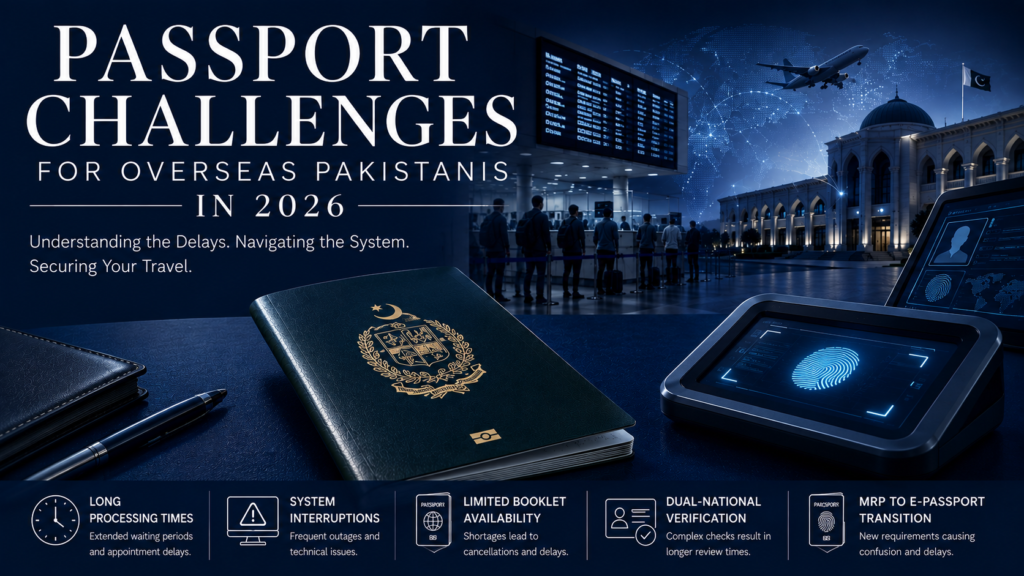
I still remember sitting in the waiting area of a Pakistani consulate abroad, token number in hand, watching the display board barely move for two hours. Next to me was an elderly man who had come in for the third time that month, his renewal stuck somewhere between Islamabad and the printing queue. A student across the row was quietly panicking because her visa renewal deadline was ten days away and her passport was nowhere to be found in the tracking system. Nobody in that room was asking for anything unusual. They just wanted a valid travel document, and even that had turned into a months-long ordeal.
If you’re an overseas Pakistani in 2026, this scene probably sounds familiar. Here’s what’s actually going on, and what you can do about it.
What Are the Biggest Passport Problems Facing Overseas Pakistanis Right Now?
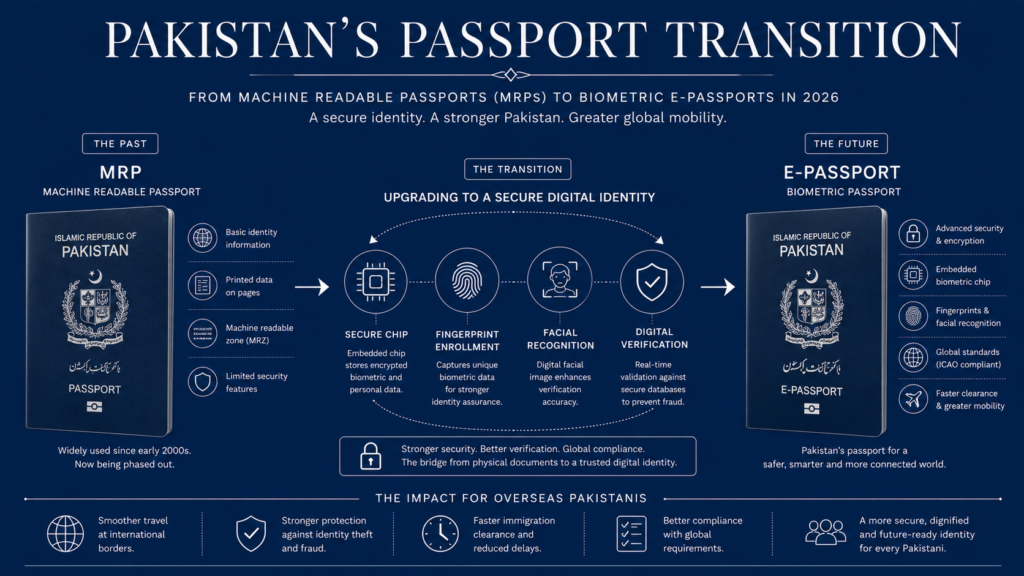
The short answer: a combination of processing backlogs, an unfinished transition to e-passports, and inconsistent service across different consulates. Applications submitted abroad are routed through a centralized system in Islamabad that is currently handling far more requests than it can process, and the ongoing shift from machine-readable passports (MRPs) to biometric e-passports has added technical friction rather than removing it, at least for now.
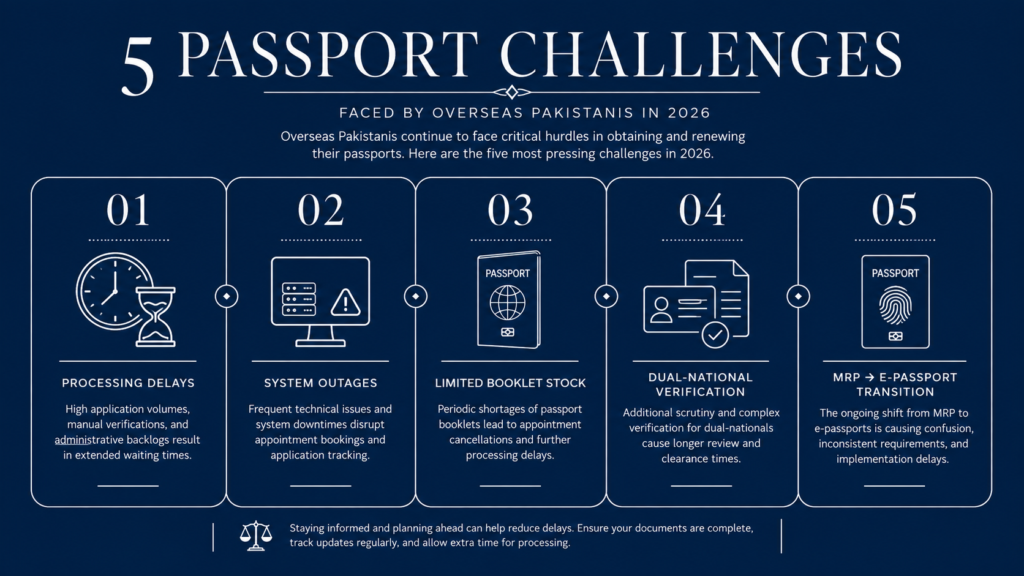
The main issues overseas applicants are dealing with:
1. Long processing delays for both new applications and renewals.
2. Periodic system-wide outages affecting every embassy and consulate at once.
3. Limited passport booklet stock at certain missions.
4. Extra document verification for dual nationals.
5. Confusion around which passport type (MRP or e-passport) applies to them.
The Backlog Nobody Warned You About
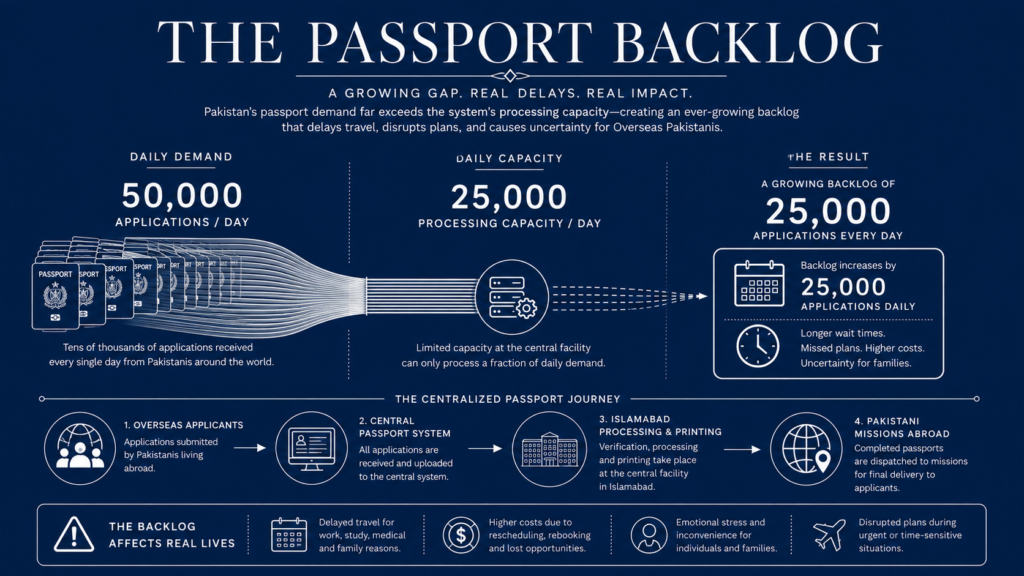
This isn’t a small, isolated problem. Domestically, Pakistan’s passport department has been receiving around 50,000 applications a day while only having the capacity to process about 25,000, leaving more than 500,000 people waiting on passports they had already paid for. That imbalance doesn’t stay contained within Pakistan’s borders. It ripples straight into consulate processing times abroad, since most applications still get routed back to the same central printing system.
In the UK, one community assessment found that urgent passports were arriving in 35 to 45 days instead of the promised 5, while normal passports were taking 50 to 70 days against a stated 12-day turnaround. And in May 2026, the disruption reached a breaking point: passport services at Pakistani missions worldwide, including in Saudi Arabia, the UAE, and Oman, were temporarily suspended entirely due to a technical failure at the central system in Islamabad.
Why this keeps happening:
1. Passport printing and data verification remain centralized in Islamabad rather than distributed regionally.
2. Some embassies, including those in the UK, Qatar, Saudi Arabia, and Australia, have reported running out of blank passport booklets.
3. Staffing at overseas missions hasn’t scaled with the growing size of the diaspora.
4. A single technical fault at headquarters can freeze services at every mission simultaneously.
The E-Passport Transition: What’s Actually Changing in 2026
To be fair to the government, 2026 has brought the most aggressive reform push the passport department has attempted in two decades, and some of it genuinely helps overseas Pakistanis. Interior Minister Mohsin Naqvi approved a full transition from MRPs to e-passports in June 2026, with the stated goal of ending passport fraud and forgery. Starting July 20, 2026, missions in the UAE, one of the largest hubs for the Pakistani diaspora, began issuing only e-passports, with more countries expected to follow the same phased rollout.
Changes worth knowing about if you’re applying from abroad:
1. All passport offices went cashless on July 1, 2026, so applicants abroad and their families back home now pay via QR codes through JazzCash, Easypaisa, or similar apps rather than cash at National Bank branches.
2. Home delivery of passports is being extended overseas, with DHL handling delivery to applicants outside Pakistan.
3. A dedicated mobile app (potentially built into the Pak ID platform) is being developed so overseas Pakistanis can apply without visiting a consulate for initial submission, though biometric capture will likely still require an in-person visit.
4. An AI chatbot is being built to walk applicants through document requirements and procedures.
5. Existing MRPs remain valid until their printed expiry date, so there’s no need to rush a replacement if yours hasn’t expired.
Extra Hurdles If You’re a Dual National or Applying on Behalf of Family
If you hold dual nationality, or if your application requires verification through relatives in Pakistan, expect additional friction. Document verification for dual nationals often takes longer because it involves cross-checking with NADRA and sometimes requesting attestations from family members back home, turning what should be a routine renewal into a process that drags on for months. Biometric mismatches and facial recognition failures during the digital transition have also pushed some applicants back into manual processing, which defeats the purpose of going digital in the first place.
Groups feeling this most acutely:
1. Students with looming visa renewal deadlines.
2. Migrant workers whose employment status depends on a valid passport.
3. Elderly applicants who have limited digital literacy or nearby consular access.
4. Dual nationals whose documentation needs cross-verification with Pakistani authorities.
What You Can Actually Do About It
None of this means you’re powerless while waiting. A few things genuinely help:
1. Apply for renewal at least four to six months before your passport expires, not when you’re already down to your last few weeks.
2. Use the official online MRP renewal portal (onlinemrp.dgip.gov.pk) rather than relying solely on in-person consulate visits.
3. Keep your CNIC or NICOP details updated with NADRA before applying, since mismatches are one of the most common causes of delay.
4. If your passport is significantly overdue, file a formal complaint through the FM Portal or the Pakistan Citizen’s Portal rather than only calling the consulate.
5. For cases stuck for an unreasonable length of time, the Wafaqi Mohtasib (Federal Ombudsman) accepts complaints about passport office delays and has previously ordered inspections in response to complaint volume.
The Bottom Line
Overseas Pakistanis contribute over $41 billion a year in remittances, more than 20 times the country’s typical foreign direct investment, yet something as basic as passport renewal remains one of the most frustrating parts of staying connected to home. The reforms underway in 2026 (cashless payments, home delivery, e-passports, a future mobile app) are real steps forward, but they’re still catching up to a backlog that built up over years. Until the system fully stabilizes, your best protection is starting early, applying online where possible, and knowing exactly where to escalate when things stall.
Frequently Asked Questions
Why are Pakistani passport renewals abroad taking so long in 2026?
A daily application volume that exceeds processing capacity, combined with a centralized printing system in Islamabad and an ongoing transition to e-passports, is the main cause of extended wait times for overseas applicants.
Do I need to replace my machine-readable passport with an e-passport right now?
No. Existing MRPs remain valid until their printed expiry date. The government has approved a full transition to e-passports but has not set a mandatory cutoff date for replacing valid MRPs.
Can I apply for a Pakistani passport renewal without visiting a consulate?
Overseas Pakistanis who already hold an MRP can apply for renewal online through the government’s e-service portal, though biometric capture for e-passports may still require an in-person visit.
What should I do if my passport application has been delayed for months?
File a formal complaint through the FM Portal or Pakistan Citizen’s Portal, and if the delay continues without resolution, escalate to the Wafaqi Mohtasib’s office, which handles complaints against government service delays.