
Inheritance is one of the basic legal as well as religious concepts in Pakistan, which deals with the distribution of the estate of a deceased individual. In Pakistan, inheritance involves the distribution of a person’s property and assets, including money, jewels, land, and property, among others. Throughout 2026, the inheritance system has become transparent through integration with digital technology. The essence of inheritance is based on Islamic law.
Whether one is faced with the loss of a loved one or planning for the future, it is necessary to have knowledge of all these laws to ensure that one gets their “Haq” (share) as required by the law of the land.
1. The Legal Foundation
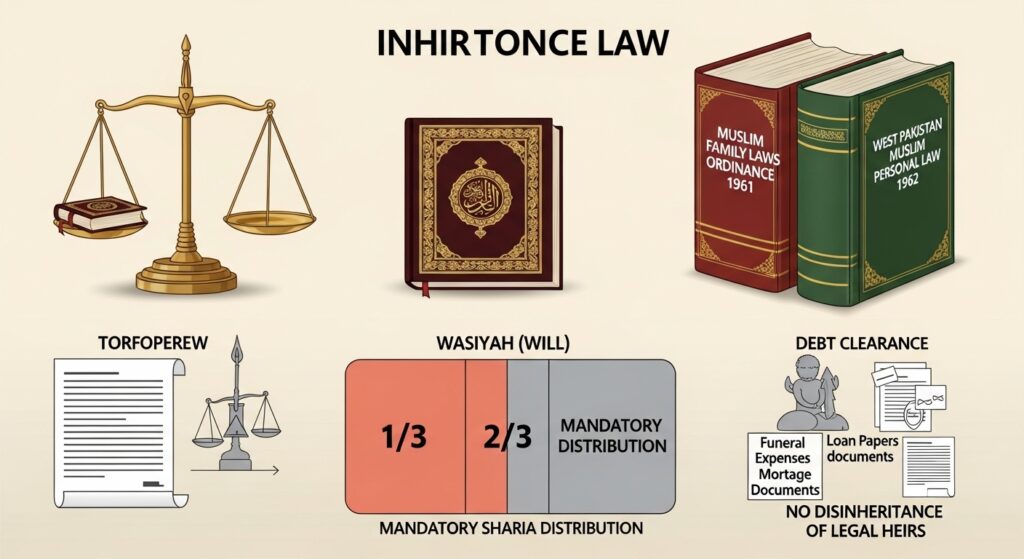
The inheritance law in Pakistan is a mix of Islamic Shari’a principles and statutory laws like the Muslim Family Laws Ordinance, 1961, and the West Pakistan Muslim Personal Law, 1962.
Debt Clearance: The estate cannot be distributed till all funeral expenses and due debts or mortgages of the deceased person are cleared.
The 1/3 Will Rule: A testator who wants to donate up to one-third of his or her estate to someone or a cause other than a legal heir through a will (Wasiyah). The remaining two-thirds must follow the mandatory Sharia distribution.
No Disinheritance: Legally, a person cannot “disinherit” a rightful heir from the 2/3 portion of the estate.
2. The Hierarchy of Legal Heirs
Heirs are categorized into three main classes. The presence of a “higher” class relative can sometimes exclude or reduce the share of those in lower classes.
| Class | Description | Common Heirs |
| 1. Sharers | Primary heirs with fixed shares are mentioned in the Quran. | Spouse, Parents, Daughters. |
| 2. Residuaries | They receive whatever remains after the sharers take their portion. | Sons, brothers, and paternal uncles. |
| 3. Distant Kindred | Blood relatives who only inherit if no sharers or residuaries exist. | Maternal aunts/uncles, cousins. |
3. How the Shares are Divided
Distribution is mathematically precise and changes based on the family structure.
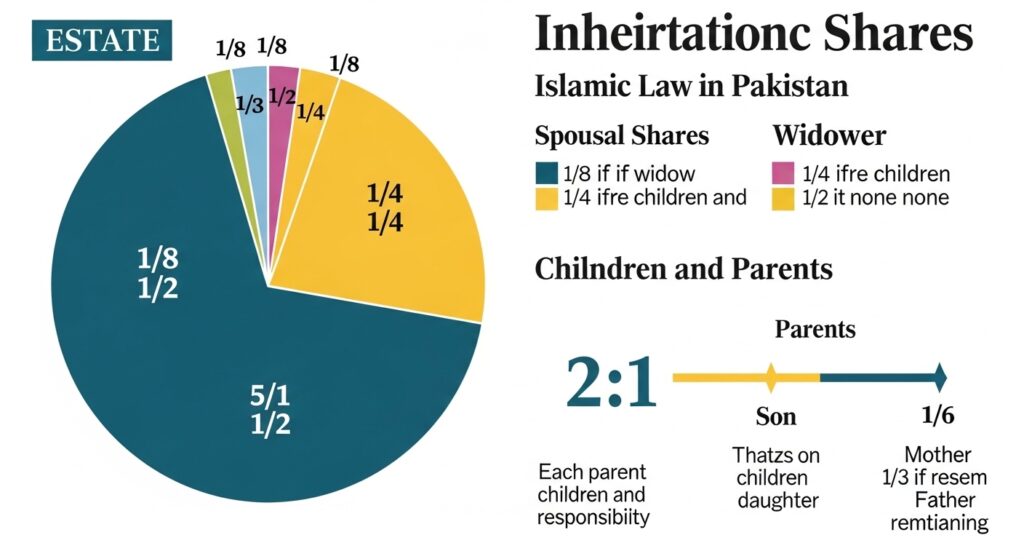
Spousal Shares
- Widow (Wife): Receives 1/8 of the estate if there are children. If there are no children, her share increases to 1/4.
- Widower (Husband): Receives 1/4 if there are children and 1/2 if there are no children.
Children and Parents
- The 2:1 Ratio: Generally, a son receives twice the share of a daughter. This reflects the traditional legal responsibility of men to provide financial support for the family.
- Parents: If there are children, the mother and father get 1/6 each. The mother’s share usually increases to 1/3 if the deceased is childless, and the father gets the rest.
4. Modern Reforms and Women’s Rights (2026)
Although laws have always existed to protect women, the enforcement in 2026 is at an all-time high.
- Criminal Penalties: The criminal offense is the deprivation of one’s inheritance through the use of deceit, coercion, or social pressure. The consequences for the offender in Pakistan, as per the PPC Section 498A, involve 5-10 years of prison, along with a fine of PKR 1 million.
- Digitized Records: Over 90% of land records have been computerized. When a death occurs, the system sends an automatic message to the revenue department to process the Intiqal (inheritance transfer), which cannot be manipulated by male relatives against female relatives.
- 2026 Fact: As recent Gallup Pakistan polls indicate, though 63% of homes claim to provide women their rightful shares, 35% of the population today, mostly women, believe these rights are being denied with regard to law awareness.
5. The NADRA Succession Process
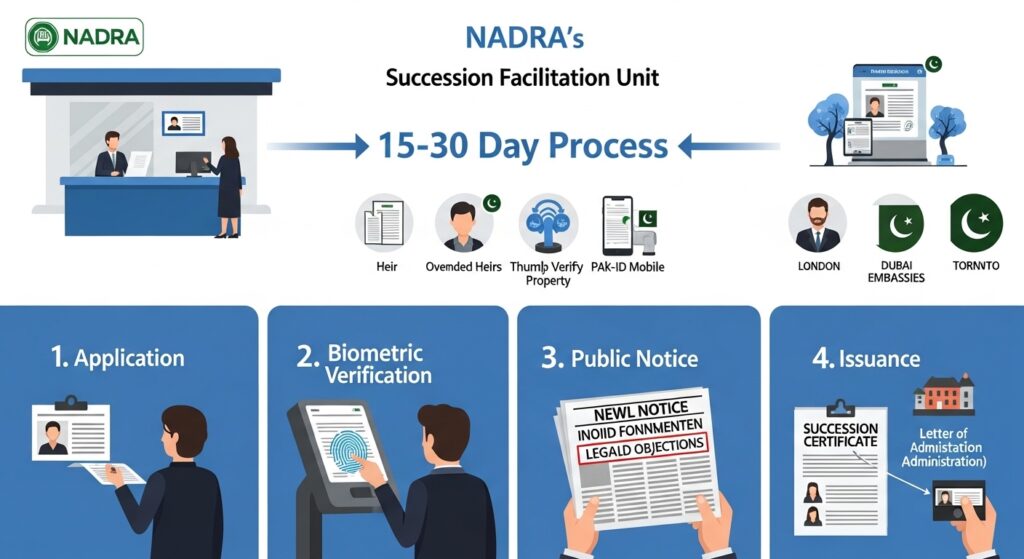
In 2026, you no longer need to spend years in civil court for an undisputed inheritance. NADRA (National Database and Registration Authority) now handles this through a streamlined 15-to-30-day process.
Application: An heir applies to a NADRA Succession Facilitation Unit.
Biometric Verification: All legal heirs will be required to give their thumbprints. The overseas heirs will be able to verify their identity through the Pak-ID app or at any Pakistani mission abroad, which may include cities like London, Dubai, and Toronto.
Public Notice: A national newspaper notice is given to invite any objections.
Issuance: If no objections are raised in the next 14 days, NADRA issues a Succession Certificate (for movable property) or a Letter of Administration (for property).
Conclusion: Securing Your Legacy
Inheritance law in Pakistan has been devised for the maintenance of stable families and financial justice, which is achieved by balancing religious ethics and legal enforcement. With the use of digital technologies like online portals of NADRA and awareness of the legal consequences of deprivation, families can ensure inheritance without compromising religious and national laws.