
A couple came to our office a few years ago convinced their case would be straightforward. They had already been informally caring for a relative’s child for over a year and simply wanted to “make it official.” The first thing we had to explain wasn’t a form or a filing fee. It was that the word they kept using, adoption, doesn’t actually exist as a legal category in Pakistan the way they imagined it.
That single misunderstanding derails more families than any paperwork ever does, so let’s start exactly where they did.
The One Fact You Need to Understand First
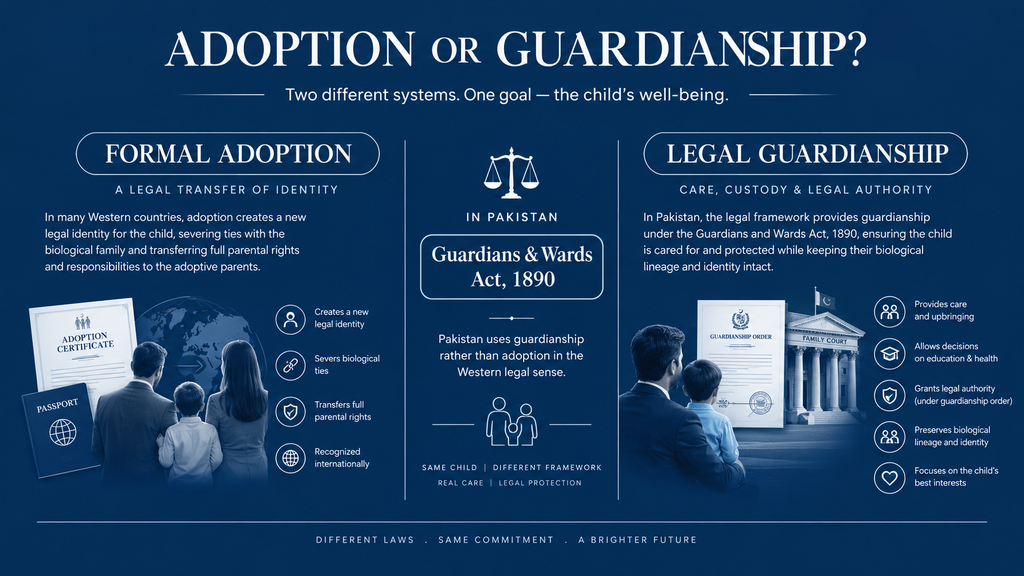
Pakistan does not recognize formal adoption in the Western legal sense. Because Islamic law does not permit severing a child’s biological lineage, the entire legal framework instead operates through guardianship under the Guardians and Wards Act, 1890. In practice, this achieves most of what people associate with adoption, custody, care, decision-making authority, a legal relationship, just structured differently.
1. There is no law in Pakistan that transfers a child’s legal identity the way adoption does elsewhere
2. What exists instead is court-appointed legal guardianship
3. The Islamic concept of Kafala (sponsorship or care of an orphan) is the religious foundation this system reflects
4. A child raised this way keeps their legal connection to their biological family, including their name and lineage
With that foundation in place, here are the 15 steps that actually matter.
The 15 Steps, Explained
1. Accept that you’re pursuing guardianship, not adoption. Every document, court order, and legal right that follows will use this terminology, and understanding it early avoids confusion later in the process.
2. Confirm your eligibility to apply. Courts generally look for a stable home, sufficient financial means, and genuine capacity to care for the child, regardless of whether you’re applying as a couple or as a single individual.
3. Identify the correct court. The petition must be filed in the Guardian or Family Court with jurisdiction where the child ordinarily resides, not necessarily where you live.
4. Prepare the petition under Sections 7 and 10. This application must state the child’s name, sex, religion, date of birth, and residence, along with the names and residence of the child’s parents and the specific grounds for the guardianship request.
5. Gather your supporting documents. This typically includes identity documents, proof of residence, financial records, and any available documentation about the child’s current circumstances.
6. File the petition and await the court’s notice process. The court will issue notices to relevant relatives and interested parties, giving anyone with a legitimate objection the opportunity to be heard.
7. Expect the court to assess suitability. Judges weigh the applicant’s circumstances directly against the welfare of the child, which Section 17 of the Act makes the single overriding consideration in the entire case.
8. Apply for interim custody if needed. Under Section 12, the court can grant temporary custody while the full case is still proceeding, which matters if the child’s situation requires immediate stability.
9. Attend hearings and respond to any objections. If a relative or other party contests the application, this stage is where evidence and testimony are actually presented.
10. Receive the court’s decision. If satisfied, the court issues a formal Guardianship Order, the legal document that establishes you as the child’s recognized guardian.
11. Understand what the order does and doesn’t grant. It gives you legal authority over the child’s care, education, and upbringing. It does not rewrite the child’s biological lineage or inheritance status.
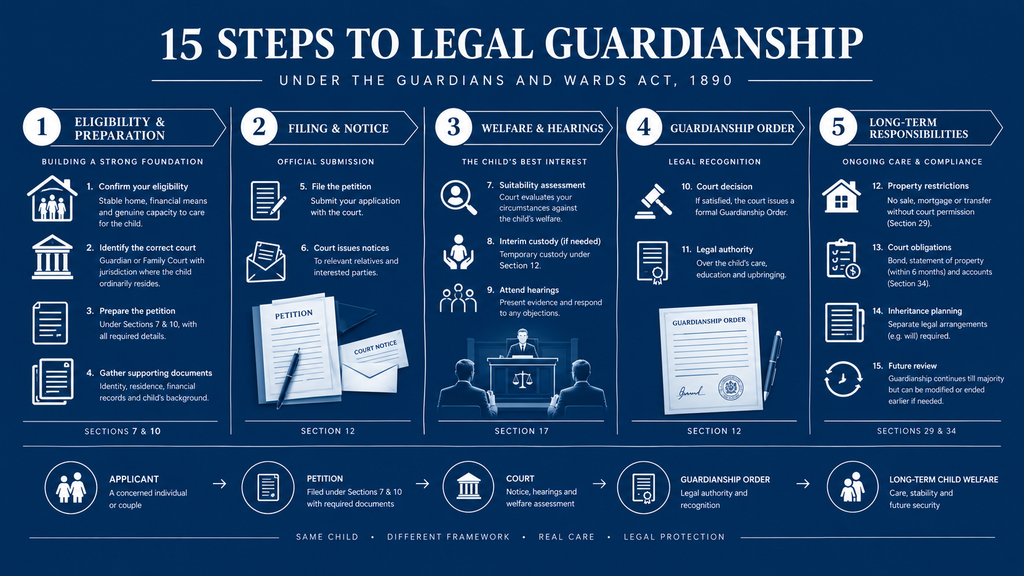
12. Know the limits on managing the child’s property. If you’re also appointed guardian of the child’s property, Section 29 prohibits selling, mortgaging, or transferring any of it without the court’s prior permission, granted only where there’s genuine necessity or clear benefit to the child.
13. Be prepared for ongoing court obligations. Under Section 34, the court can require a guardian to furnish a bond, submit a statement of the child’s property within six months, and produce accounts whenever the court requests them.
14. Plan separately for inheritance. Because guardianship doesn’t create automatic inheritance rights, families who want to secure the child’s financial future usually need a separate legal instrument, such as a will, alongside broader inheritance law planning done properly from the start.
15. Know that guardianship isn’t necessarily permanent. It generally continues until the child reaches the age of majority, but it can also be reviewed, modified, or ended earlier by the court if circumstances change or the arrangement no longer serves the child’s welfare.
Where This Connects to Broader Family Matters
Guardianship cases rarely exist in isolation. They often surface alongside broader family law matters, particularly where custody is contested or where the child’s biological parents remain legally involved in some capacity.
1. Disputes can arise between a guardian and a biological parent who later re-enters the picture
2. Property matters involving the child may also require separate action under civil law, especially where inherited assets are involved
3. International or cross-border guardianship cases add further complexity, since Pakistan is not a party to the Hague Adoption Convention, making foreign recognition of a Pakistani guardianship order a separate legal question entirely

Final Thoughts
The gap between what people expect from “adoption” and what Pakistani law actually provides through guardianship causes more confusion than almost any other area of family law we handle. Once that terminology is understood, the process itself is manageable, but it does require getting the paperwork, the court, and the long-term planning right from the very first filing. If you’re considering this step, contact us before you begin, not after a petition has already been filed incorrectly.